Robotics in Manufacturing — Little Bits STEM Camp Curriculum
A five-day, fully scripted facilitator curriculum that any camp instructor can pick up and teach — culminating in a student-built remote-controlled vehicle.
- Role
- Sole Designer & Facilitator
- Audience
- STEM campers, incoming grades 1–7
- Timeline
- 5 days · station-based
- Format
- In-person, facilitated
A five-day curriculum for the littleBits station at Robotics in Manufacturing, a STEM summer camp serving incoming grades 1–7 and hosted inside community programs such as Boys & Girls Clubs. I was assigned the station, which had no existing curriculum, and built the entire unit from scratch. It takes campers with no prior experience from “what is a circuit?” to building and driving their own remote-controlled vehicle by the end of the week.
Across a summer the camp runs up to several weeks with three or more instructors, cycling five station groups of up to fifteen campers through each day — reaching hundreds of campers in all. That scale put consistency first: any instructor had to pick the unit up and teach it the same way, even with no background in the technology.
So every day is scripted for a single instructor running a station group start to finish: timing, materials lists, sample dialogue, the target circuit at each step, and the trouble points to expect — with scripted responses to the misconceptions campers predictably hit.
How the week builds
Each day adds one layer and ends a step closer to the vehicle:
- Day 1 — the four bit types (power · input · output · wire) and building a first working circuit with a button, latch, and lights.
- Day 2 — combining multiple inputs, the branch wire bit, and a proximity sensor that reacts to distance instead of touch.
- Day 3 — the inverter wire bit (making outputs behave the opposite way) and richer outputs: the seven-segment number display and the LED matrix.
- Day 4 — the DC motor as a controllable output: spin direction (CW / CCW / VAR), and a dimmer to vary speed. By the end of the day campers have assembled the two-motor, variable-mode circuit that drives the car.
- Day 5 — campers follow a circuit diagram to build a working remote control, wire it to the vehicle, and test it against a performance checklist.
Differentiation and the design behind it
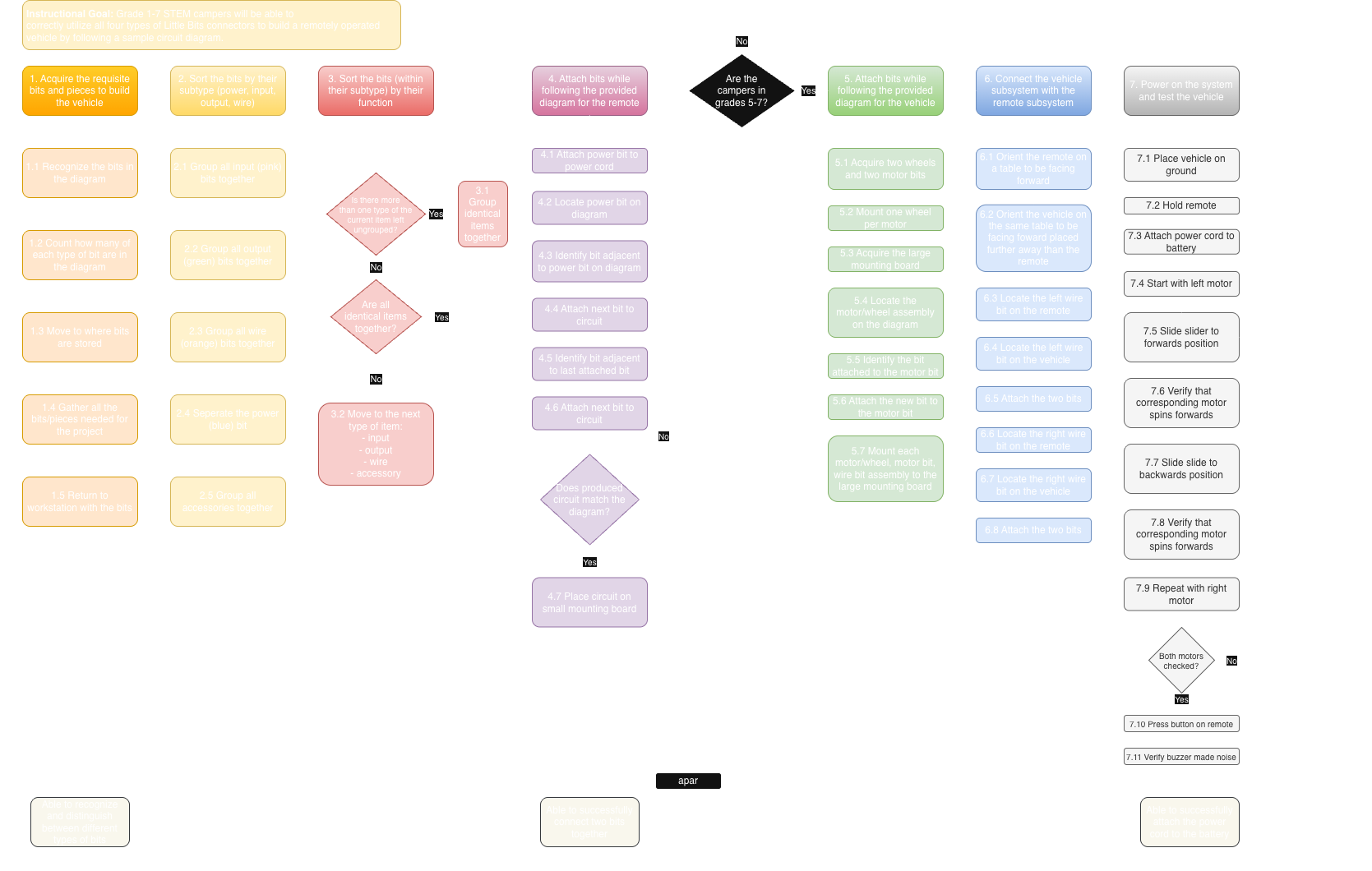
The unit has age-based differentiation built in — older campers assemble the vehicle chassis as an extension activity, while younger campers receive it pre-built so the lesson stays focused on the circuit. The design follows the Dick & Carey model; the goal-analysis diagram below maps the terminal objective down to the enabling skills each day teaches.
Outcomes and what piloting changed
I piloted the culminating module and drew on field observations across multiple summers of instruction. Formative testing showed campers retained the core content — bit types and their functions — and completed the builds. It also surfaced two issues I then designed around:
- Wire-bit connections that separate under rough handling.
- A meaningful difference in how younger and older campers handle the equipment.
So I changed the supply method: instructors now distribute pieces directly instead of campers retrieving them, which recovers instructional time and removes a per-step verification bottleneck.
The displayed document is the full five-day facilitator guide. A complete Dick & Carey design document — needs assessment, learner and context analysis, performance objectives, and assessment alignment — is available on request.
On mobile, inline PDF preview may not render — use Open PDF or Download above.